
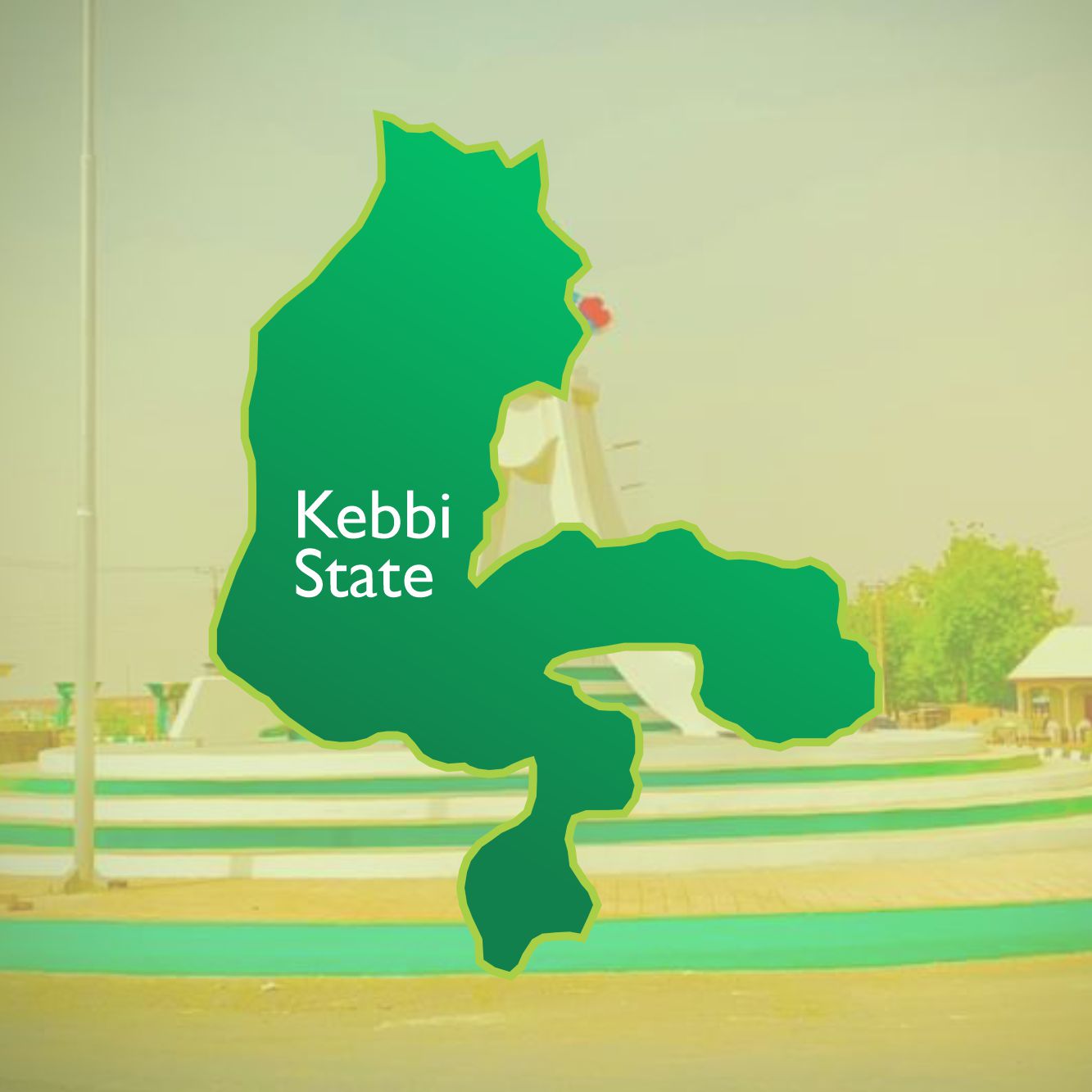
About Kebbi State
Tugged between the largely arid landscape of Niger republic to the West, Sokoto, Zamfara and Niger States to the North, East and South respectively, Kebbi State spreads alluringly over a vast expanse of Sahelian land of approximately 36,229 square kilometers, representing 3.92% of the total land area of Nigeria. In this wonderfully endowed land, lives a population of 4million proud Hausa –Fulanis and other tribes enamored by a long unwinding history papered by memories of spectacular accomplishments.
Created out of Sokoto State on August 27,1991, with Birnin Kebbi as capital, the geographical location known as Kebbi today derived its name from the 14th century “Kebbi kingdom” which was a province of the erstwhile Songhai Empire in present day Mali.
At present, the state is made up of four Emirates (Gwandu, Argungu, Yauri and Zuru) which are further divided into 21 Local Government Areas: Birnin Kebbi, Bagudo, Ngaski, Yauri, Sakaba, Danko-Wasagu, Zuru, Koko-Besse, Dabai, Suru, Maiyama, Jega, Bunza, Arewa, Gwandu, Argungu, Aliero, Augie, Fakai, Shanga and Kalgo. Due to its geographical location, Kebbi State provides two of Nigeria’s gateways to the West African sub-region. This unique position enhances cross border socio-economic activities between the communities to the state and those adjacent countries.
Climate
The state enjoys a tropical climate, which is generally characterized by two extreme temperatures, the hot and cold temperatures. The rainfall begins in May/June and ends in October with the heaviest fall occurring in July and August. Generally, rainfall varies between the northern and southern parts of the state both in terms of intensity and duration with the latter region experiencing more sustained and heavier downpours. The extremely cold harmattan period, usually accompanied by dust-laden winds and fog, prevails in November, December and January. Mean annual temperatures vary considerably but usually at 100F or 70F, while mean annual rainfall is about 500mm.
Environment/Agriculture
Kebbi State has one of the most agriculturally viable environments since it is endowed with high soil fertility, vast farmlands and economically viable rivers sheltered by fine tropical climates. Owing to these factors, agriculture has remained the major source of revenue to the people. Corn, maize, cassava, potatoes, rice, beans, onions, and vegetables are the crops while cash crops like wheat, soya beans, ginger, sugarcane, groundnuts and tobacco are also produced in abundance. Similarly, fruits such as mangoes, cashew,. Guava and pawpaw are produced under horticulture. In addition, environmental factors, as well as the large concentration of cattle and other animals, have made the state a basic raw materials source for any dairy product industry.
The state is blessed with economically viable rivers such as Niger and Rima for the development of fishery activities. In fact some 70% of the total landmass of Kebbi State is covered by these two rivers, which tellingly enhance the scenic beauty of the state. The fine tropical climate and the low savannah vegetation, which provides good habitat for a variety of wild life, further complement this. Thus, fishing has always been one of the key occupations of the inhabitants of the state.
Culture
Hausa is the predominant language although other inhabitants speak dakarchi, Kambarci and Zabarmanci. Islam is the predominant religion.
Education
The state government recognizes that education is the basic ingredient for socio-economic and technological advancement. Consequently, it is committed to ensuring that the people attain high standards in education. As a corollary, nomadic education is also encouraged to improve the level of understanding for the wandering nomads in every nook and cranny of the state. The state has primary schools and post-primary schools scattered all over the State in all its 227 wards. In addition, the state is blessed with tertiary institutions namely, Waziri Umaru Federal Polytechnic, Birnin Kebbi; Federal University of Agriculture, Zuru; Federal University, Birnin Kebbi, Abdullahi Fodio University of Science and Technology Aliero, College of Nursing Birnin Kebbi, Sajo College of Nursing Birnin Kebbi, College of Health Technology, Jega, College of Education, Argungu, College of Preliminary Studies, Yauri, school of Nursing and Midwifery, Birnin Kebbi and a University of Science & technology in Aliero. Together with a number of Islamic schools, these centres of learning offer quality education to teaming young people in and around the state.
The state has undergone tremendous industrial and commercial growth since its creation in 1991. The Government has over the years emphasized the development of industries with bias towards import substitution and export-oriented labour intensive factories.
Economic Activities
The main occupation of the inhabitants of the state revolves around farming, fishing and distributive trade. At the moment, it is a place where most local government spending is initiated. It is also a place where major economic activities are centred on property development, commerce, private and governmental organizations. In the area of commercial banking, virtually all banks operating in the country have established presence in the state.
The State is blessed with over a dozen mineral resources ready to be tapped and harnessed.
The over 200 kilometres of arable fadama land provides opportunity for all year round rice, wheat, maize and vegetable cultivation.